Lau Fau Shan: Oysters by the Bay
Some fine restaurants too

Lau Fau Shan: Oysters by the Bay
Some fine restaurants too
One of the more bizarre sculptures I’ve ever encountered is a 2.5 metre statue of an oyster that stands proudly on the waterfront at Lau Fau Shan. The shell faces out across Hau Hoi Wan, or Deep Bay in English, which marks the border between the Hong Kong Special Administrative Region and the rest of China. What would be the soft, fleshy part of the oyster looks inland, towards the village.
The brackish waters along the edges of the bay are a perfect habitat for oysters, and in times past, they brought fame and fortune to Lau Fau Shan. At its peak, over a hundred tons of the molluscs would be harvested each year, but over time, the waters became too polluted and the industry all but died out. The water quality has recovered considerably in recent years, and oysters are once again being farmed, but their cultivation is still a far cry from its former glory.


Dried seafood and restaurants on Lau Fau Shan Main Street

Live seafood wholesaler
The village, however, remains a vibrant fishing community and, for those in the know, boasts some fine seafood restaurants. For some venues, it is best to go with a group of friends, but when I’m alone, there are smaller places that can rustle up a plate of fried or steamed prawns, a delicious pompano, or a red snapper in black bean sauce.
Lau Fau Shan Main Street is a narrow lane, mostly covered, and lined with stalls selling a comprehensive range of marine products, fresh, dried, and pickled. There are snapper, grouper, flounder, and sea bass. Squid, octopus, cuttle fish, starfish, sea horses, a full complement of crustaceans and more mollusc species than I could count. Condiments, too, fish and oyster sauces and shrimp paste among them.


A steamed mangrove red snapper, and dim sum from The Palace Restaurant
Further along, Wellington booted wholesalers tend huge tanks filled with the most recent catches, while hoses and pumps keep the water circulating and aerated. Trucks collect most of the catch in the early mornings and ferry it away to restaurants and retailers all over Hong Kong.
The lane ends where it meets the water, which varies depending on the tide. Here, you are likely to find a cluster of people expertly shucking recently harvested oysters. At high tide, egrets perch on the sides of boats while gulls bob up and down on the water, each scanning the depths for their own breakfast. When the tide is low, the slipway tapers directly onto the mud, while the towers of Shenzhen corrugate the far shore (main image).

Shucking oysters near the waters edge
Perched on a hill overlooking the village and the bay is the old Lau Fau Shan police station. It is an impressive structure, built in 1962 to keep an eye out for smugglers and illegal immigrants. It was decommissioned in 2002 and listed as a grade III heritage building. It now serves as the Guide Dogs Academy, a college for young pups to train for a life as a service dog for the blind and other special needs.
There had been plans to turn it into a restaurant, but that role was already adequately filled by The Palace Restaurant, which sits on the road just below. The Palace boasts a peaceful, leafy patio where one can tarry over a fine selection of dim sum and tea.


Main altar at the Yuen Kwan Tai Temple (left) and the statue of an oyster
One place I was keen to revisit, while I was in the area, was the old Yuen Kwan Tai Temple in Mong Tseng Wai. This involves employing the services of a number 35 green minibus for a bumpy ride along Deep Bay Road.
An inscription on the temple bell indicates it was founded in 1692. It has been renovated numerous times since then, the most recent just a few years ago. It was a rather derelict place last time I visited; now it is a splendid home for the two deities, Yuen Tai (also known as Pak Tai) and Kwan Tai, who are honoured there.

The view of Shenzhen from across the bay
In the late afternoon, I like to wander back along the Lau Fau Shan Main Street to the slipway and the water’s edge. It is a perfect spot to watch both the sun going down and the towers of Shenzhen lighting up. The giant oyster adorns an open space just to the left, and next to it are some inspirational signs written in Chinese. I’m not sure if they are meant to be read as couplets, but the messages, when translated, are quite charming. The first one reads, “Make a wish upon the stars. See you in Lau Fau Shan.”
The K65 bus route serves Lau Fau Shan. It starts from the Yuen Long bus terminal just down the escalator from Exit G of the MTR. It can also be caught at the outside of Exit B at Tin Shui Wai MTR.
Sign up for The Mango Road newsletter
Exploring Hong Kong, Macau, and the Greater Bay Area
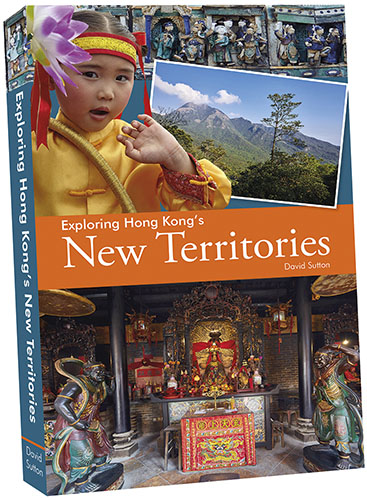
Exploring Hong Kong’s New Territories
The New Territories represents around 85% of Hong Kong’s total land area. It is an area of coastal wetlands and mountains boasting a history of more than a thousand years. There are many ancient monuments, well-maintained hiking trails and outlying islands with old fishing communities. Yet to most visitors, it remains largely unknown.
I spent the Covid years researching, writing and photographing it. Exploring Hong Kong’s New Territories is 332 pages with around 400 colour photographs plus maps and directions. More information here